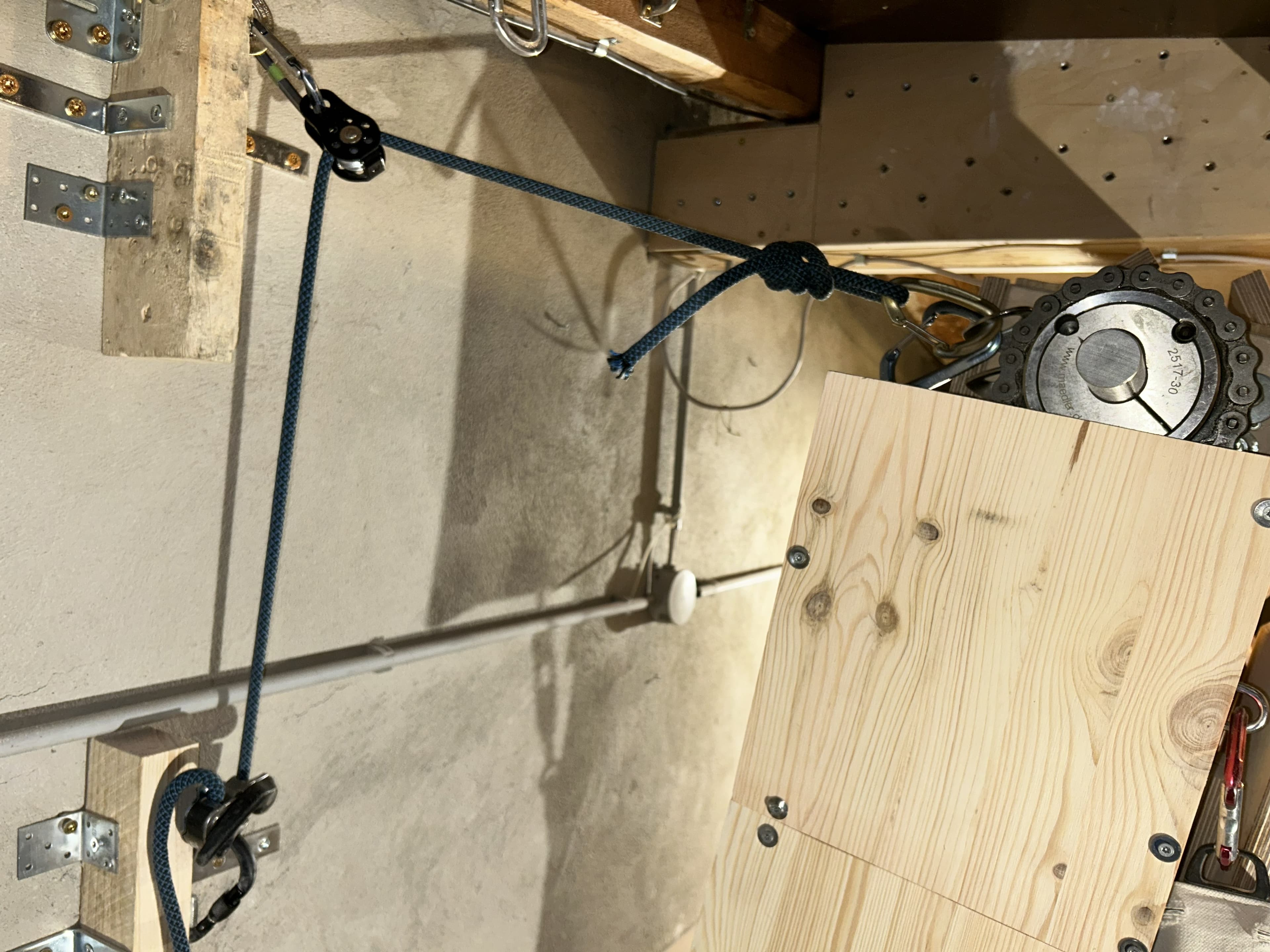
If you want to build an Endless Climbing Wall at home, one of the biggest decisions is whether to go with an anchored setup or a freestanding setup.
Both can work. But they solve the problem in very different ways.
An anchored Endless Climbing Wall uses the building itself as part of the support system. A freestanding Endless Climbing Wall carries all forces within its own frame. That difference affects almost everything: stability, footprint, drilling requirements, complexity, and how the wall will fit into your space.
This article is not a technical anchoring guide. It is a practical comparison to help you decide which route makes more sense before you build.
Quick Answer
In many home setups, an anchored Endless Climbing Wall is the more direct and compact solution if the building allows it. A freestanding Endless Climbing Wall becomes more attractive when drilling is not possible, but it usually needs more structure, more footprint, and more careful planning to achieve the same level of stiffness and predictability.
The Core Difference
The easiest way to understand the difference is this:
- an anchored setup transfers part of the load into the building
- a freestanding setup keeps all of the load inside its own support frame
That one difference changes the whole design logic.
With an anchored wall, the floor, wall, or beam helps you.
With a freestanding wall, the structure has to help itself.
When an Anchored Endless Climbing Wall Usually Makes More Sense
An anchored setup usually makes the most sense when your room gives you access to strong structural fixing points.
That could mean:
- a floor you can anchor into
- a roof beam or upper structural beam
- a strong wall that can safely carry load
- a space where a more permanent installation is acceptable
The big advantage of an anchored system is that it lets the building do part of the work. That usually means you can create a stable setup with less extra structure around the wall.
Why many home builders prefer anchored setups
An anchored setup is often attractive because it is:
- more compact
- more direct in the load path
- easier to keep stiff
- often cleaner visually
- usually better when space is limited
If the building structure is suitable, anchoring can be the most straightforward way to get a stable Endless Climbing Wall at home.
When a Freestanding Endless Climbing Wall Usually Makes More Sense
A freestanding setup becomes much more interesting when the building cannot be used.
That may be the case if:
- drilling is not allowed
- the floor should not be damaged
- the walls are not suitable for anchors
- there is no strong upper beam
- the space is rented or temporary
- you want a more independent structure
This is where freestanding construction has a real advantage. It gives you a path forward even when the building itself is not usable as a support system.
Why people are drawn to freestanding designs
Freestanding builds are attractive because they offer:
- no drilling into floor or walls
- more independence from the room structure
- flexibility in difficult or restricted spaces
- a solution for people who cannot use anchors at all
That said, the freedom of a freestanding system comes with a structural price.
The Real Trade-Off: Building Structure vs Extra Frame Structure
This is often the deciding factor.
If you anchor the wall, the building absorbs part of the force.
If you do not anchor the wall, your frame has to grow stronger, larger, and stiffer to make up for it.
That means a freestanding design often needs:
- more timber or support material
- more diagonal bracing
- a larger footprint
- more attention to tipping resistance
- more overall stiffness in the frame
So the question is not only, “Can I avoid drilling?”
The better question is:
Do I want to transfer complexity into the building, or into the support frame?
Which Setup Is Better for Small Rooms?
In many cases, an anchored Endless Climbing Wall is better for smaller rooms.
Why? Because when the building carries part of the load, the support structure around the wall can often stay more compact. You do not need as much floor footprint to create stability.
A freestanding setup usually needs more space around it because the base and bracing must be large enough to stop the wall from moving or tipping.
So if your room is tight, anchoring often helps you save space.
Which Setup Is Better If You Cannot Drill?
If you truly cannot drill into the floor, walls, or beams, then freestanding is usually the more realistic path.
That is exactly where it makes sense.
But it is important to be honest about what that means. Freestanding does not mean easier. It usually means the opposite. It can mean:
- more structural planning
- more material
- more footprint
- more attention to stiffness
- more need for overbuilding rather than underbuilding
So if you cannot drill, freestanding may be the right decision, but it should be chosen with clear expectations.
Which Setup Usually Feels More Predictable?
In many cases, anchored setups feel more predictable because the wall is tied directly into fixed structural points.
That often creates a stronger sense of confidence when the wall is loaded or tilted.
Freestanding setups can also feel solid, but only if they are built with enough stiffness and enough geometric stability. If they are underbuilt, they are more likely to feel flexible, unsettled, or less confidence-inspiring.
This does not mean freestanding is bad. It means the margin for weak design is smaller.
Which Setup Is More Permanent?
Anchored walls are usually the more permanent solution.
They are ideal if:
- you know where the wall will live long term
- you want the structure integrated into the room
- you are comfortable treating it as a serious fixed installation
Freestanding walls can be useful when you want more independence from the room, but they are not automatically easy to move just because they are not drilled in. A properly built freestanding wall can still be large, heavy, and awkward.
So “freestanding” should not automatically be understood as “portable.”
Which Setup Requires More Trust in the Building?
This is another useful way to compare them.
Anchored setups require more trust in the building. You need confidence that the floor, wall, or beam you are using is actually strong enough for the loads involved.
Freestanding setups require less trust in the building, but much more trust in your own frame design.
So the choice is often:
- trust the building
- or build enough structure that you do not need to
Where Hybrid Solutions Fit In
Not every room leads to a pure anchored or pure freestanding solution.
Sometimes the smartest option is somewhere in between.
A hybrid setup may make sense if:
- you can anchor at the top, but not into the floor
- you want a timber base but still use a wall anchor
- one part of the room is structurally useful and another is not
- you want to reduce footprint without fully relying on the building
Hybrid solutions are often the most realistic answer in home environments because real rooms are rarely ideal.
They also allow you to combine the strengths of both directions:
- some help from the building
- some independence from the frame
A Practical Decision Framework
If you are unsure which route makes more sense, this simple framework helps.
Anchored usually makes more sense if:
- you can drill safely into the building
- you want a compact setup
- you want a more direct and proven structural path
- you want the wall to feel very fixed and stable
- you are comfortable with a permanent installation
Freestanding usually makes more sense if:
- drilling is not possible
- the building structure is unsuitable
- you need independence from the room
- you have enough floor space for a larger support frame
- you are willing to build more structure to create stability
Hybrid usually makes more sense if:
- your room only allows partial anchoring
- you need a compromise between compactness and flexibility
- you want to adapt the support concept to a non-standard space
My Honest View
If the room allows it, an anchored Endless Climbing Wall is often the more straightforward choice.
It usually gives you a more compact structure, a clearer load path, and a more direct way to create a stable build.
Freestanding setups absolutely have their place, especially when anchors are not possible. But they should be chosen because they fit the constraints of the room, not because they sound simpler. Structurally, they are usually the more demanding route.
That is why the best option is not the one that sounds easiest in theory. It is the one that fits your room honestly.
Final Thoughts
The decision between freestanding and anchored is really a decision about where the support comes from.
An anchored Endless Climbing Wall gets support from the building.
A freestanding Endless Climbing Wall gets support from its own frame.
Neither is automatically right or wrong. The better choice depends on your room, your drilling options, your footprint, and how much structural complexity you want to handle inside the build itself.
If you choose the support concept early and base it on the reality of your space, the rest of the project becomes much easier to plan.
Related Questions
Is an anchored Endless Climbing Wall better than a freestanding one?
Not always, but in many home setups it is the more compact and direct solution if the building allows safe anchoring.
Can a freestanding Endless Climbing Wall be safe?
Yes, but it needs enough footprint, stiffness, and bracing to carry all forces without help from the building.
Which Endless Climbing Wall setup is better for a garage?
If the garage has a suitable floor and strong upper structural points, an anchored setup is often the better fit.
Which setup is better if I live in a rental?
A freestanding or hybrid setup may be more practical if drilling into the building is restricted.
Is freestanding the easier option?
Usually not. It avoids drilling, but often requires more structural planning and more support material.